



 l.By Manoj Bhusal
A Public school in western Nepal offers a new educational model that could significantly change Nepal’s primary and secondary education system.
Public schools in Nepal do not excite many as they are not renowned for quality education. Establishment of democracy in 1990 gave rise to privatization and private schools mushroomed in the country. Many Nepalis wish to send their children to private schools which are said to be expensive, but offering world class education in Nepal.
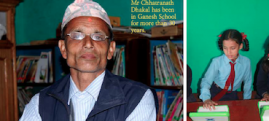
However, amidst expensive private schools and sleazy public schools there are some exceptions. Ganesh Secondary School in Narayansthan Baglung is one such exception, which being a public school surpasses the expectations that one could have from a cutting edge private school in Nepal.’Students from private schools have joined our school in large numbers,’ says Chhatranath Dhakal, Nepali teacher of the school who has been there for more than thirty years and have witnessed all the ups and downs of the school.
 Mr Dhakal argues that sheer willpower of the teaching staff, proactive support and enthusiastic participation of the School Management Committee and financial and moral support from non-governmental organizations, such as Social Welfare Association of Nepal (SWAN), has given Ganesh school a new fame in western Nepal.
See Also: Why Keep Spending in Education?
Ganesh School’s success in the School Leaving Certificate (SLC) examinations has been extraordinary. Students have passed the exams with distinction marks and overall success rate is significantly higher than in other public schools in the region. It’s not only the SLC results that make Ganesh School a peculiar one. ‘Our students are far more vibrant and creative if generally compared to other public or private schools in the district’, claims Raju Tripathi, a Social Studies teacher who relinquished his dream of studying in the West and travelled all the way from Chitwan to Baglung, with a passion to teach underprivileged Nepali children and make a difference in rural Nepal.
Unlike in many public schools in Nepal, students at Ganesh School play with laptops since they are in primary grade. They know how to communicate in English and delivering an instant speech is not a problem. ‘We have emphasized on English medium teaching because that’s time’s demand and that’s how a world-class manpower is born,’ argues Rudra Bahadur G.C. ‘Milan’ who is known as the sturdy Mathematics teacher in the school.
‘We have come a long way,’ says, Surendra Acharya, a member of the school management committee and also a SWAN representative, ‘nobody believed us in the beginning when we came up with this idea of an wonderful school in the Narayansthan village’. Mr Acharya believes that Ganesh School has become a brand name by now, but maintaing that name will be a challenge in the days to come. That’s what he worries about frequently.

While many public schools in Nepal have been victims of regular strikes and seem to be easily accessible battlefields of political organizations, Ganesh School has been declared a ‘peace-zone’. Local political forces have taken a vow and as a result there are no political strikes or ‘bandh’ in the school.
‘Things are not perfect though,’ accepts Chhatranath Dhakal, ‘it would be wonderful to have a school bus, a compound wall and a clean and better organized hostel’.
The School Management Committee and the staff team is grateful to organizations that provide all possible support to them. SWAN has a School Support Program for Ganesh School and provides logistical and financial support, for instance, to build infrastructure, acquire land and to provide scholarships for the needy and underprivileged children. ‘Students that studied with SWAN’s assistance have achieved remarkable success in their respective fields’, claims Dhruba Shrestha, SWAN’s Program Manager, ‘and without SWAN’s support that would have been very difficult, if not impossible’, he adds.
See Also: How Free is Free Education in Kenya & Uganda?
SWAN’s history of working with remote and marginalized communities in Baglung is a long one. ‘It’s been a long journey and our hair has turned grey,’ jokes Raju Tuladhar, SWAN’s Executive Director, in his Kathmandu office where he is busy planning future activities of the organization. Established in 1994, SWAN works in different areas; education and child development being one of its top priorities.

Manoj is the founder and Editor-in-Chief of Global South Development Magazine. He holds a Master's Degree in International Development Studies from the University of Helsinki, Finland and is deeply passionate about international development issues. His areas of academic interest include peace and conflict studies, transitional justice and reconciliation processes and south-south cooperation in international development.

